
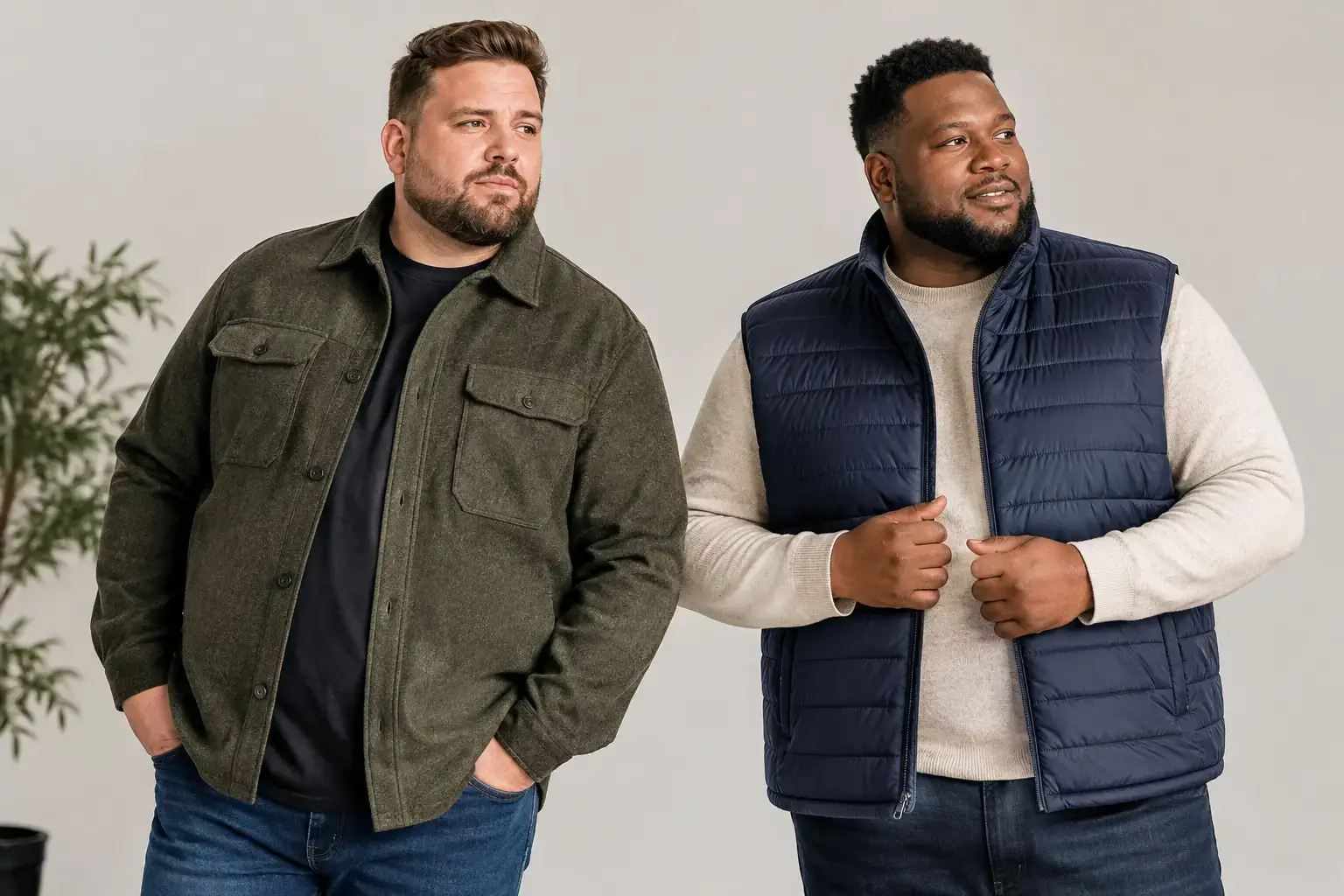
The search query “men’s overshirt or cardigan” seems simple, but your choice determines how comfortable you’ll feel all day long. An overshirt adds structure to your outfit and gives it a rugged look. A vest, on the other hand, is quick to put on and take off and works great as an extra layer. For men who wear larger sizes, it’s not just the style that matters: the roominess around the shoulders, waist, and arms makes the difference between a garment that looks good and one that you actually enjoy wearing.
An overshirt is a sturdy shirt jacket that you wear open or buttoned over a T-shirt, polo shirt, or thin sweater. It usually has a collar, buttons or snaps, and often chest pockets. This makes it look more dressed up than a regular shirt, while being less formal than a blazer. It’s a versatile piece for leisure, a dinner out, an informal workday, or a weekend getaway.
A cardigan is softer, sportier, and easier to layer. Think of a zippered sweatshirt, a zippered hoodie, or a fine-knit cardigan. You can easily take it off when it gets warmer and wear it comfortably over a T-shirt or polo shirt. This is especially practical if you’re on the go a lot.
So the best choice doesn't just depend on what you think looks better. You should also consider the season, your daily activities, and the fit you prefer. If you're looking for a relaxed, put-together casual look, you'll often end up choosing an overshirt. If warmth and freedom of movement are your top priorities, you'll more often opt for a cardigan.
An overshirt is ideal when a T-shirt feels too simple, but a jacket is too warm or too heavy. It instantly adds structure to your outfit without making you look too tight or overly dressed up. Especially in plus sizes, a well-chosen overshirt works beautifully as an outer layer: it creates a defined line at the shoulders and keeps the outfit looking balanced.
Choose a cotton blend, twill, denim, or a slightly heavier flannel fabric if you plan to wear the overshirt in the spring, fall, and on cooler summer evenings. A thinner cotton style is better suited for indoors or for days when you mainly want to have an extra layer on hand. Make sure the fabric isn’t too stiff. An overshirt should allow for movement when you’re sitting, driving, or moving your arms.
An overshirt can be looser-fitting than a regular shirt, but it doesn’t have to be shapeless. The shoulder seam should fall on or near your own shoulder. If the shoulders are too narrow, the fabric will pull at the upper arms and between the shoulder blades. If they’re too wide, the entire look will sag, and the garment will appear larger than necessary.
Also check the chest and waist measurements. If you want to wear an overshirt buttoned up, it should close without feeling tight. Do you almost always wear it open over a T-shirt? In that case, the fit can be a little roomier, but even then, sufficient sleeve length is essential. Sleeves that ride up or are too tight around the upper arm can quickly make an otherwise attractive style less comfortable.
For a versatile base, dark blue, olive green, charcoal gray, and sand are great choices. These colors pair easily with jeans, stretch pants, or chinos. A checkered pattern or denim overshirt adds more character, but keep the shirt underneath simple. A solid-color T-shirt or polo shirt brings balance to the outfit.
A cardigan beats an overshirt when comfort is key. A zippered sweatshirt, for example, is a logical choice for a walk, a day of sports, running errands, or a relaxing evening at home. You can wear it open when you get warm and zip it up as soon as it cools down. That’s also handy in the car, at the office, or during a visit where the temperature fluctuates.
For men with a broader build, a vest with a good zipper and a slightly longer back is often more comfortable. It stays in place better and provides extra coverage when you sit or move. When choosing a hoodie, pay attention to the hood: it should be roomy enough without pulling heavily on your neck. A hoodless style usually looks a bit more understated and is easier to wear under a jacket.
A knit cardigan is the more polished option. Worn over a shirt or polo shirt, it pairs well with a business-casual outfit. A sweatshirt, on the other hand, is the more relaxed choice when paired with jeans, sweatpants, or casual pants. The difference lies not only in the material but also in the look. So don’t automatically choose the warmest cardigan—instead, choose the one that suits where you plan to wear it.
The length of a vest is often underestimated. A vest that’s too short can ride up around the stomach, especially when you sit down. A well-fitting vest usually falls just past the waistband and stays there even when you move. This creates a neater look and feels more comfortable.
A zipper is practical, but make sure it glides smoothly and doesn’t bulge. For a button-up cardigan, it’s important to have enough room around the waist. Buttons that are under tension pull the front panels apart. That’s not a matter of style, but a sign that a larger size or a different style would be better.
Want a casual outfit that looks put-together? Wear a dark overshirt over a white, black, or dark blue T-shirt, paired with comfortable jeans and stylish sneakers. The overshirt often serves as a replacement for a light jacket. On a slightly cooler day, you can wear a thin sweater underneath, as long as the overshirt has enough room around the arms and chest.
A cardigan actually pairs perfectly with layering. A polo shirt with a sweatshirt and elastic-waist pants is comfortable for a day off, yet still looks put-together enough for an outing. For a sportier look, choose a T-shirt, a zip-up hoodie, and jeans or sweatpants. Avoid wearing too many bulky layers at once: a thick hoodie under a heavy winter coat may keep you warm, but it often restricts your range of motion.
For work where a suit isn't required, a fine-knit cardigan over a shirt can be a good compromise. Choose a solid-color cardigan in dark blue, gray, or black, and make sure the shirt collar lies neatly. This way, your outfit will look professional without feeling stiff.
A 3XL from one brand may fit differently than a 3XL from another brand. Therefore, don’t just look at the size you normally order, but focus especially on the measurements and the style. For an overshirt, shoulder width, chest circumference, and sleeve length are the key factors. For a vest, chest circumference, length, and the room around the waist and upper arms are especially important.
Measure a garment you already like while it’s lying flat, and compare those measurements to the size chart. Measure the chest from armpit to armpit, the length from the shoulder, and—for an overshirt—the shoulder width as well. This will help you avoid choosing a size based solely on a hunch that turns out to be too tight or too loose in practice.
Are you torn between two sizes? First, consider how you’ll wear the garment. An overshirt that you wear over a T-shirt can be less roomy than one that also needs to fit over a sweater. With a cardigan, a slightly roomier size is often more comfortable if you’re using it as an extra layer. A slimmer fit, on the other hand, might work better if you’re wearing it mainly indoors or under a coat.
At Biggymans Kleding, you’ll find casual men’s clothing in plus sizes ranging from 2XL to 14XL, so you can choose based on fit rather than settling for whatever happens to be available. If you’re having trouble figuring out your size using the size chart, please contact customer service for personalized advice. At our store in Almere, you can also try on clothes at your leisure, with extra-wide aisles, spacious fitting rooms, and free parking right out front.
An overshirt is the best choice if you're looking for a rugged, polished layer that adds flair to your casual outfit. A cardigan is ideal when comfort, warmth, and the ability to quickly transition between indoors and outdoors are more important. Both are valuable wardrobe staples, as long as the shoulders fit well, the length is right, and you have enough room to move freely.
So don't just look at the color or style on the screen. Think about your favorite T-shirts, polo shirts, jeans, and pants—and choose the piece that pairs effortlessly with them. Browse the full collection and order the style that combines comfort and style for you.